You know that moment in a DJ set when a track doesn’t just stop—it whispers away? One note hangs in the air like a ghost, then another, softer. The kick drum dissolves into a shimmer of reverb until all that’s left is the memory of a beat and the crowd leaning in, waiting for what comes next. That’s the smooth echo out fade. It’s not just a way to end a song. It’s a way to pause time, to let the room breathe, and to signal that something fresh is about to land. If you’re trying to elevate your transitions from “fine” to “flawless,” this technique is a must-have in your creative toolkit.
Let’s be real: most DJs learn the basics—beatmatch, EQ out, drop the next track. That works for a house party or a warm-up slot. But the smooth echo out fade? That’s where you start sounding like someone who actually feels the music, not just someone who plays it. Here’s how it works. You take the outgoing track, engage the echo or delay FX on your mixer (most modern gear has a built-in beat-synced delay), and gradually increase the feedback while simultaneously closing the channel fader. As the fader goes down, the echoes get longer, more prominent, until the original signal is gone and all you hear is a trailing series of repeats that decay into silence. The key word here is smooth. You’re not chopping the track off. You’re letting it dissolve like sugar in hot coffee.
The beauty of this technique is how it plays with time and space. A properly executed echo out creates a moment of tension and release. The crowd hears the last recognizable phrase, then watches it stretch into oblivion. It’s a psychological reset. For two or three seconds, the floor is empty. Then, when you drop the next tune—ideally one with a solid kick or a vocal hook right on the one—the impact hits twice as hard. It’s the DJ equivalent of a deep breath before a cannonball.
Timing is everything. You don’t want to do this during a peak-energy section where the crowd is jumping. That’s when you want to slam mix or chop. The echo out fade works best at transition points: the end of a breakdown, after a big drop has started to lose steam, or when you’re moving between genres. Picture you’re mixing out of a deep house track into something more minimal or ambient. The smooth echo out lets you shed the rhythmic baggage and land softly in a new mood. It’s also gold for radio or podcast-style mixes where you want to avoid abrupt silence.
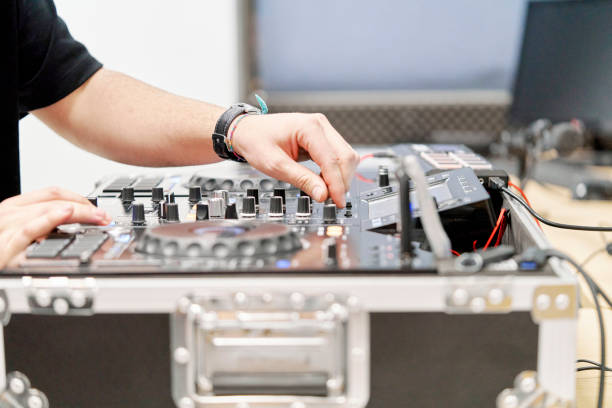
Gear matters but not as much as your ears. A Pioneer DJM mixer with the beat FX delay is the standard, but you can replicate this on almost any controller using a send/return loop with a delay pedal or in software like Serato DJ Pro or Rekordbox. Set your delay time to match the outgoing track’s tempo—quarter notes or eighth notes usually work best. Start with the effect wet/dry knob at zero, then bring it up to about 50% while you pull the channel fader down. As the fader reaches the bottom, push the feedback until the echoes sustain and then self-oscillate slightly before fading. The trick is to ride the feedback knob so it doesn’t get too shrill or clip your master.
One pro move: combine it with a high-pass or low-pass filter. If you filter out the lows while echoing, you get a cleaner, more airy fade. If you filter out the highs, it gets moody and dark. Another move is to echo out only the last word of a vocal phrase or a specific percussive hit. That creates a signature moment—your audience might not know why it felt so good, but they’ll feel it.
Avoid the echo out trap, though. Don’t use it on every track. It loses its magic if the crowd gets used to it. Save it for tracks with clear endings, sparse arrangements, or when you want to emphasize a lyrical moment. Also, be careful with long delays in a loud room—too much feedback can create a mudslide of noise. Trust your monitors and your eyes on the waveform.
In the grand tradition of DJs like Larry Levan, Frankie Knuckles, and Wendy Hunt, creativity in the mix has always been about more than just playing records. It’s about sculpting energy. The smooth echo out fade is one of those subtle gestures that separates a good night from a great story. When you nail it, people don’t clap. They just nod and lean closer, because they know you’re not just mixing tracks. You’re mixing feelings.
So next time you’re in the booth and that last chorus is ringing out, don’t rush. Twist that delay knob. Let the echo breathe. And fade out like you mean it.