# 360 Sound Stages: How Immersive Audio Is Rewriting The DJ Set
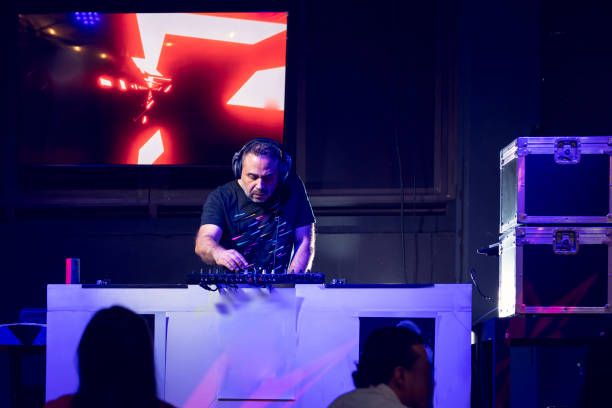
You’re at a warehouse party. The kick drum hits your chest, sure, but now it’s also vibrating through the floorboards behind you. A synth pad swirls from your left ear, wraps around the back of your head, and dissolves into the crowd’s chatter somewhere near the bar. This isn’t a fever dream. This is the future of DJing, and it’s being built inside a 360-degree sound stage.
For decades, DJ culture has been about two speakers pointed at a crowd. Stereo was the holy grail. Then surround sound tried to sneak into home theaters, but it never really stuck for live mixing because DJ gear and club rigs weren’t designed for it. That’s changing fast. We’re now entering the era of immersive audio formats, and the development of 360-degree sound stages is the physical and digital infrastructure that’s making it happen. Think of it like going from a Polaroid to a VR headset. Your ears are about to get a whole new dimension.
So what exactly is a 360-degree sound stage? In the simplest terms, it’s a spatial audio environment where sound isn’t just panned left or right. It’s placed in three-dimensional space. You can hear a hi-hat above your head, a bassline crawling along the floor, and a vocal drifting in a circle around the room. This is possible thanks to object-based audio formats like Dolby Atmos, MPEG-H, and Sony’s 360 Reality Audio. But the real magic happens when those formats are paired with specially designed playback systems—arrays of speakers arranged in a sphere or dome, often coupled with head-tracking technology. For DJs, this means your mix becomes a sculptural, moving thing. You’re no longer just blending tracks. You’re arranging sound architecture.
The development of these stages is happening at an insane pace. Clubs in Berlin, Tokyo, and Los Angeles are retrofitting their main rooms with ceiling-mounted speakers and subwoofer rings that create a true 360 field. Brands like Funktion-One and L-Acoustics are already prototyping immersive rigs that work with standard DJ setups. The goal? To make it so a DJ can load a standard track into a spatial mixing environment and manually “place” elements of the song in the room. Imagine cueing a synth lead, flicking a knob, and throwing it behind the crowd. That’s not a gimmick. That’s a new palette.
For DJs, the learning curve is real but exciting. Traditional beatmatching still matters. Phrasing and energy flow still rule. But now you’ve got to think about spatial hierarchy. Which element gets the front of the room? Which one gets the back? Is the vocal floating or grounded? This is where the history of DJ trailblazers comes full circle. Frankie Knuckles and Larry Levan built entire sets around the physical feel of the room—the vibration, the sweat, the echo. Wendy Hunt used feedback loops and delay to make the speakers feel alive. They were doing spatial audio without the tech. Now we have tools that can do it with precision.
The mental shift is huge. DJs who grew up on two decks and a mixer suddenly have to learn spatial mixing workflows in software like Ableton Live with spatial plugins, or on hardware like AlphaTheta’s new spatial controllers. It’s not about dropping a track and letting it run. It’s about composing a live audio sculpture. And the best part? The crowd feels it immediately. Studies show that immersive audio increases emotional engagement and even makes people dance longer. That’s a club owner’s dream and a DJ’s secret weapon.
Of course, there are challenges. Not every venue can afford a full 360 rig. And mixing for spatial audio requires monitors that can reproduce the field, which many DJs don’t have at home. But the industry is moving fast. Portable 360 sound pods are being developed for festivals. Streaming platforms like Tidal and Apple Music already support spatial audio, so DJs can practice with those mixes at home. The barrier to entry is dropping every quarter.
The real takeaway here is that immersive audio isn’t just a format. It’s a philosophy shift. It says that the DJ’s job is no longer to just play music for a crowd. It’s to create a listening environment that the crowd lives inside. Larry Levan would have killed for this tech. Frankie Knuckles would have used it to make the Paradise Garage feel like a spaceship. And you, the DJ reading this, get to be the first generation to treat the entire room as your instrument. So start saving for those ceiling speakers. The future is 360 degrees, and it’s already spinning.